Perilous Interventions by Hardeep Singh Puri
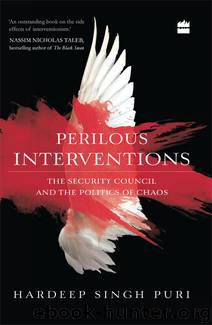
Author:Hardeep Singh Puri
Language: eng
Format: epub
Tags: null
Publisher: HarperCollins Publishers India
Published: 2016-04-06T04:00:00+00:00
5
YEMEN AND THE OTHER ELEPHANT IN THE TENT
My earliest recollections of Yemen are clouded in memories of brief stopovers in the leafy port city of Aden in the late 1950s or early 1960s, accompanying my parents by ship from Bombay (now Mumbai), to Karachi, Aden, Port Said in Egypt and then on to Genoa in Italy. That brief stopover was repeated three years later in the reverse direction when my father completed his assignment and we were returning to India. That was the prescribed route then, or, in Government of India parlance, the ‘approved’ route for anyone assigned to an Indian diplomatic mission in Europe. Air travel was still relatively rare. Two identical passenger ships of Italian shipping company Lloyd Triestino (now called Italia Marittima), MV Asia and MV Victoria, built in 1953, with a displacement of 11,500 tons, operated as luxury liners between Italy and the Far East. My memories are of a thriving port city, bustling commerce, and the good looks of its population. I was too young to understand the unfolding political developments a year before the Yemen Arab Republic, also known as North Yemen, was set up in 1962. This set the ground for the civil war between the royalists, who had hitherto ruled the country, and the republicans backed by Egypt.
Fast-forward from 1962 to 1978. Ali Abdullah Saleh came to power and held office—first as the president of North Yemen until 1990 and then as that of the current Republic of Yemen, formed after the North’s unification with South Yemen that year—till he was forced to quit in 2011. His method of ruling, which he likened to ‘dancing on the heads of snakes’, would include ‘destroying civic forms of association and any kind of institution that existed in Yemen, whether from the Zaidi monarchical period or from the few presidents who ruled before him in the republic’.1
Yemen featured regularly on the agenda of the Security Council during India’s tenure in 2011–12. In early 2011, over 16,000 Yemenis, exasperated with the existing system, took to the streets in Sana’a, the capital city, in mass protests emulating the Arab Spring. While the protests initially echoed the reasons for dissent in Tunisia and Egypt—unemployment, worsening economic conditions, and so on—the demand list soon escalated to calls for Saleh to resign, even as attempts were made to make changes to the constitution that would allow Saleh to continue in office for another ten years.2 The GCC drew up an agreement forcing Saleh to give up power in favour of his vice-president, Abd Rabbuh Mansur Hadi.
Fifty-two years after I last saw Yemen, I was all set to visit the country again. This time because India was serving its seventh term as a non-permanent member of the Security Council. That visit—which would have been my third—alas, could not take place. The physical security of the fifteen members of the UN Security Council could not be guaranteed for a short five-hour transit visit not even involving an overnight stay.
The Security Council undertakes
Download
This site does not store any files on its server. We only index and link to content provided by other sites. Please contact the content providers to delete copyright contents if any and email us, we'll remove relevant links or contents immediately.
| Anthropology | Archaeology |
| Philosophy | Politics & Government |
| Social Sciences | Sociology |
| Women's Studies |
The Secret History by Donna Tartt(19480)
The Social Justice Warrior Handbook by Lisa De Pasquale(12300)
Thirteen Reasons Why by Jay Asher(9134)
This Is How You Lose Her by Junot Diaz(7061)
Weapons of Math Destruction by Cathy O'Neil(6487)
Zero to One by Peter Thiel(5955)
Beartown by Fredrik Backman(5952)
The Myth of the Strong Leader by Archie Brown(5632)
The Fire Next Time by James Baldwin(5595)
How Democracies Die by Steven Levitsky & Daniel Ziblatt(5338)
Promise Me, Dad by Joe Biden(5238)
Stone's Rules by Roger Stone(5196)
A Higher Loyalty: Truth, Lies, and Leadership by James Comey(5092)
100 Deadly Skills by Clint Emerson(5034)
Rise and Kill First by Ronen Bergman(4908)
Secrecy World by Jake Bernstein(4896)
The David Icke Guide to the Global Conspiracy (and how to end it) by David Icke(4856)
The Doomsday Machine by Daniel Ellsberg(4632)
The Farm by Tom Rob Smith(4614)
